

Evidence, organised

Brain & Mental Wellbeing

Explore claims about stress, anxiety-related wellbeing, focus, memory and brain health. Investigations include supplements, nervous-system trends and ideas about trauma.

A cognitive test, a biological marker and feeling better in daily life do not answer the same question. We explain the population studied, the measured outcome and what the research leaves uncertain, without judging people for being curious.

Questions to explore

Explore relevant Evidence Shelf recommendations →

Filter by topic, evidence or outcome

Browse by category

Evidence rating

Ratings describe support for the exact claim, not whether an ingredient is good or bad. Investigations with mixed claim-specific ratings remain in All ratings until an overall rating is designated.

More filters

Choose an ingredient or topic and an outcome to narrow your results.

Browse published investigations below.

Evidence vs Hype editorial illustration asking whether omega-3 improves mood, with fish-oil capsules, a glass of water and a brain teaching model.

Can Omega-3 Supplements Really Help Treat Depression?

EPA-rich omega-3 may help some adults alongside established depression treatment. Mixed trials and low-certainty findings limit claims about reliable benefit.

Read the evidence →
Evidence vs Hype: cocoa flavanols — sharper memory? Cocoa pod, powder and dark chocolate.

Can Cocoa Flavanols Really Improve Your Memory?

LIMITED — There are encouraging findings for some cognitive tasks and for people with lower initial diet quality or flavanol intake. Large trials have not shown a consistent overall memory or cognition benef...

Read the evidence →
Evidence vs Hype: fish oil — prevents dementia? Softgels and an unbranded supplement bottle.

Can Fish-Oil Supplements Really Prevent Dementia?

WEAK — Omega-3 fats matter to normal biology, but routine fish-oil supplements have not been shown to reliably prevent dementia. Some studies report improvements in particular cognitive tests or brain measur...

Read the evidence →
Evidence vs Hype artwork showing an adult resting a hand over the chest and another on the abdomen, asking about self-soothing touch and stress.

Can Putting Your Hand on Your Heart Really Lower Cortisol and Stress?

LIMITED — A randomised experiment found a smaller cortisol response after a self-soothing-touch exercise, but participants did not clearly feel less stressed than controls. Newer trials suggest brief touch c...

Read the evidence →
Evidence vs Hype artwork with creatine powder and a thoughtfully seated adult, asking about depression without promising a cure.

Can Creatine Really Help Treat Depression?

LIMITED — Some small trials suggest benefit when creatine is added to existing depression treatment. The evidence remains uncertain, and a recent meta-analysis found an average effect below its threshold for...

Read the evidence →
Black-and-gold Evidence vs Hype artwork with coffee and a bedside scene asking whether quitting caffeine improves sleep.

Does Quitting Caffeine Really Improve Sleep, Anxiety and Energy?

LIMITED — Reducing caffeine may help when it contributes to poor sleep or jitteriness. But deliberate abstinence does not reliably improve every habitual user's sleep, and better long-term energy after a 30-...

Read the evidence →
Choline capsules, eggs and a notebook accompany the memory and focus evidence check.

Do Choline Supplements Really Improve Memory and Focus?

WEAK — Choline is essential, but nutritional necessity does not establish that extra supplementation improves cognition. Some small or selected-population studies report benefits, particularly with citicolin...

Read the evidence →
A relaxed adult wearing headphones in a peaceful studio illustrates the 9D Breathwork evidence investigation.

Does 9D Breathwork Really Release Stored Trauma?

WEAK — Breathing practices may help some people feel calmer or regulate distress, and a powerful session can feel meaningful. Direct controlled evidence that 9D Breathwork releases stored trauma or treats PT...

Read the evidence →
A simple activity list with books, walking shoes, art pencils and tea illustrates the dopamine menu idea.

Can a Dopamine Menu Really Improve Motivation and ADHD Focus?

LIMITED — A ready-made list of manageable activities can be a useful organisational idea. Its rationale overlaps with activity planning and behavioural activation, but the named 'dopamine menu' has not been ...

Read the evidence →
Evidence vs Hype conceptual artwork investigating nicotine replacement therapy, using subject-specific unbranded imagery.

Does Nicotine Replacement Therapy Really Help People Quit Smoking?

STRONG — Yes. High-quality evidence shows that licensed nicotine replacement therapy improves long-term quit rates. Combining a patch with a fast-acting form works better than one form alone, while the best ...

Read the evidence →
Evidence vs Hype conceptual artwork investigating wearable cortisol sensor, using subject-specific unbranded imagery.

Can Wearable Cortisol Meters Really Measure Your Stress Accurately?

LIMITED — Wearable sensors can detect cortisol in experimental settings, but chemical detection and a clinically accurate stress reading are different achievements. Most evidence does not establish an everyd...

Read the evidence →
Evidence vs Hype artwork comparing unbranded caffeine pouches with black coffee, asking whether pouches work faster.

Do Caffeine Pouches Work Faster or Better Than Coffee?

WEAK — Reliable evidence that pouches outperform coffee is missing. A prominent five-form absorption study was retracted; gum findings cannot validate pouches.

Read the evidence →
Questioning Evidence vs Hype editorial artwork of unbranded nicotine pouches asking about clean focus; no person using nicotine.

Do “Clean Nicotine” Pouches Really Improve Focus in Non-Smokers?

LIMITED — Nicotine has small acute effects on selected attention tasks. Direct evidence for pouches as a useful, safe focus tool in nicotine-naive adults is weak.

Read the evidence →
Evidence vs Hype menopause investigation artwork with a thoughtful middle-aged woman and generic medicine packs; no medicine use or treatment endorsement.

Can Antihistamines and Famotidine Really Relieve Menopause Symptoms?

WEAK — A biological hypothesis and personal reports do not establish the H1/H2 combination as menopause treatment. No direct controlled efficacy trial was identified.

Read the evidence →
Evidence vs Hype pinky-time artwork with adult hands and a dementia-prevention question; a conceptual image, not a diagnostic demonstration.

Can “Pinky Time” Finger Exercises Really Prevent Dementia?

WEAK — Structured finger programmes have some cognitive research, but the viral movement is not established as dementia prevention or a diagnostic test.

Read the evidence →
Evidence vs Hype slow-jogging artwork showing an adult gently running outdoors and asking about mood and focus in ten minutes.

Can Ten Minutes of Slow Jogging Really Boost Mood and Focus?

LIMITED — A small randomised crossover trial found acute mood and executive-function benefits versus rest. It did not show superiority to walking.

Read the evidence →
Evidence vs Hype exercise-and-mood investigation artwork showing an adult walking in a park, with a 15-minute timer inset. The 21% headline is a question, not a promised result.

Can 15 Minutes of Exercise Improve Your Mental Health by 21%?

WEAK — The exact 21% claim comes from a small ASICS comparison with wellness retreats. Independent evidence supports exercise for mood, without guaranteeing that percentage.

Read the evidence →
Evidence vs Hype: edible mushrooms and unlabelled capsules beside an older adult, with an anatomical brain inset. Conceptual artwork, not proven brain protection.

Can Ergothioneine Supplements Really Protect Your Brain From Ageing?

WEAK — Ergothioneine has promising biology, but brain protection remains unproven. We examine human uptake, observational research and the primary result of the 2025 trial.

Read the evidence →
Evidence vs Hype: a sleeping adult and an unbranded sleep headband, with abstract sound arcs in a gold-ring inset. Conceptual acoustic-stimulation artwork.

Can Smart Sleep Technology Really Increase Deep Sleep and Improve Memory?

LIMITED — Timed sound can influence sleep rhythms. We assess closed-loop stimulation, mixed memory trials and why a brain-wave change is not automatically more deep sleep.

Read the evidence →
Evidence vs Hype: an adult beside an unbranded bright-light box on a winter morning. Conceptual artwork, not a promise of treatment response.

Does Bright Light Therapy Really Work for Seasonal Depression?

MODERATE — Bright light therapy can help some people with winter-pattern seasonal depression when the device, timing and exposure follow a studied protocol. It is not a guaranteed cure, and evidence for prev...

Read the evidence →
Evidence vs Hype: headphones and a desk with a notebook, abstract gold sound waves no measured chart. Conceptual artwork for the investigation.

Does Brown Noise Really Improve ADHD Focus?

Some people find brown noise useful, but direct research is insufficient to establish an ADHD benefit. A meta-analysis found small task-performance benefits from white and pink noise; it found no brown-noise...

Read the evidence →
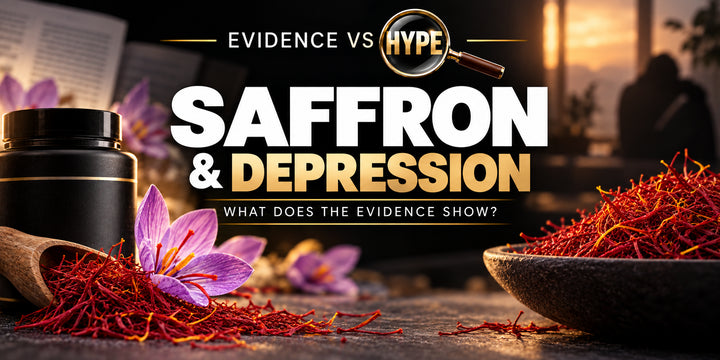
Evidence vs Hype: saffron threads and crocus flowers beside unbranded supplement bottle, respectful calm imagery no cure claim. Conceptual artwork for the investigation.

Is Saffron Really as Effective as Antidepressants?

Saffron has promising trial results for depressive symptoms, particularly in limited, short-term research. Those results do not establish that it is interchangeable with prescribed antidepressants or suitabl...

Read the evidence →
Evidence vs Hype: Does the 75 Hard Challenge Actually Make You Healthier? Conceptual editorial illustration.

Does the 75 Hard Challenge Actually Make You Healthier?

WEAK — Two workouts a day, a gallon of water and no missed tasks: 75 Hard offers a very clear challenge. Its useful ingredients should not be confused with proof that the exact rulebook makes people healthie...

Read the evidence →
Evidence vs Hype investigation cover: vitamin D softgels and a contemplative person beside a window, titled Vitamin D and Mood?

Does Vitamin D Really Improve Mood or Help Depression?

LIMITED — Treatment trials suggest a possible symptom benefit, but results vary. A large prevention trial was negative, and vitamin D does not replace depression care.

Read the evidence →
Evidence vs Hype caffeine and anxiety investigation with coffee, resting hands and a notebook; no inevitable symptoms or clinical diagnosis is depicted.

Does Caffeine Really Increase Anxiety?

MODERATE — Caffeine can increase anxiety symptoms, particularly at high doses and in susceptible people. This does not mean ordinary coffee inevitably causes an anxiety disorder.

Read the evidence →

Browse the complete Brain & Mental Wellbeing collection →

Evidence first. Products second.

The Evidence Shelf: Brain & Mental Wellbeing

Useful for defined needs. Start with who may benefit, then consider whether buying anything would add value.

Editorial imagery for the mental wellbeing buying guide

UK-led options. Evidence applies to the defined use; formulas and guidance can differ by country.

Illustrative structured cbt workbook imagery; not the exact commercial example

Illustrative product type

Structured CBT workbook

MODERATEEvidence for guided CBT self-help

This rates guided CBT self-help. Evidence for the exact book is LIMITED.

Best supported for

Structured guided CBT self-help for appropriate less severe difficulties.

Why we selected it

The verified edition contains structured CBT exercises. The rating applies to guided self-help.

Do you actually need it?

Useful for structured practice with suitable support; a book cannot replace needed care.

Safety before use: A workbook is not crisis care. Persistent or worsening symptoms call for appropriate support. Avoid implying that distress reflects failure to think positively.

Who may benefit & who can skip it

You might benefit: Adults with less severe depressive or anxiety-related difficulties who want structured practice, with support when needed.

You probably do not need it: Anyone expecting a book to replace assessment or intensive treatment during severe illness or crisis.

What to look for & important limitations

What to look for

Match the second edition: paperback ISBN 9781462520428. Look for thought records, behavioural tasks and progress review. Guided practice and appropriate support matter more than owning a book.

Important limitations

NICE describes guided self-help using printed/digital structured CBT or related approaches with practitioner support, usually six to eight sessions. Evidence for that package cannot be attributed wholly to a retail book. No trial establishing this edition as the best commercial product was verified.

Ordinary or free alternatives

Good value if actually used; keep the evidence rating attached to guided self-help rather than a guaranteed therapeutic effect from buying the book.

The evidence & product checks

The evidence

What is checked about the product?

The publisher confirms the edition and ISBN. Guided CBT self-help evidence does not independently establish this book as equivalent to clinical treatment. The verified publisher ordering page is US-led; UK retail matching remains open.

Intervention evidence, product-label checks and independent testing are separate. These examples are not claims that one brand is scientifically best.

The research links above support this guide. A dedicated investigation is not yet available.

Illustrative bright-light therapy imagery; not the exact commercial example

Illustrative product type

Bright-light therapy

MODERATEEvidence for winter-pattern seasonal depression

Best supported for

May reduce winter-pattern seasonal depression symptoms.

Why we selected it

Illuminance at a usable distance and UV filtering can be checked.

Do you actually need it?

Consider for a seasonal pattern after checking timing and suitability with a clinician.

Safety before use: Headache, eyestrain, agitation and possible mania/hypomania. Eye disease and photosensitising medicines require advice. Timing is important.

Who may benefit & who can skip it

You might benefit: Adults with a seasonal pattern who have discussed appropriateness, timing and use with a suitable clinician.

You probably do not need it: People seeking a general brain boost or a guaranteed cure for non-seasonal depression.

What to look for & important limitations

What to look for

A UV-filtered white-light lamp with illuminance stated at a usable distance. The manufacturer specifies 10,000 lux at 20 cm. Light falls with distance; timing and duration need to match an appropriate treatment plan.

Important limitations

Pjrek et al. found a standardised depression-score difference of -0.37 and response RR 1.42 across small heterogeneous trials. This is meaningful support for a specific seasonal indication, but moderate-to-high bias prevents blanket certainty. The lamps below were not shown superior head-to-head.

Ordinary or free alternatives

Potentially worthwhile for a suitable seasonal problem; needs a dedicated guide rather than a universal wellbeing card.

The evidence & product checks

The evidence

What is checked about the product?

The current UK manufacturer page documents the lamp, distance and instructions. Its device certification is not proof it outperforms other suitable lamps. No head-to-head superiority is established.

Intervention evidence, product-label checks and independent testing are separate. These examples are not claims that one brand is scientifically best.

Evidence reviewed: October 2026. Ratings assess the stated intervention and outcome, not a brand. Product links here are ordinary links with no affiliate tracking. We have not laboratory-tested these products. Affiliate disclosure · How we assess evidence.

Explore all nine Shelf categories →