
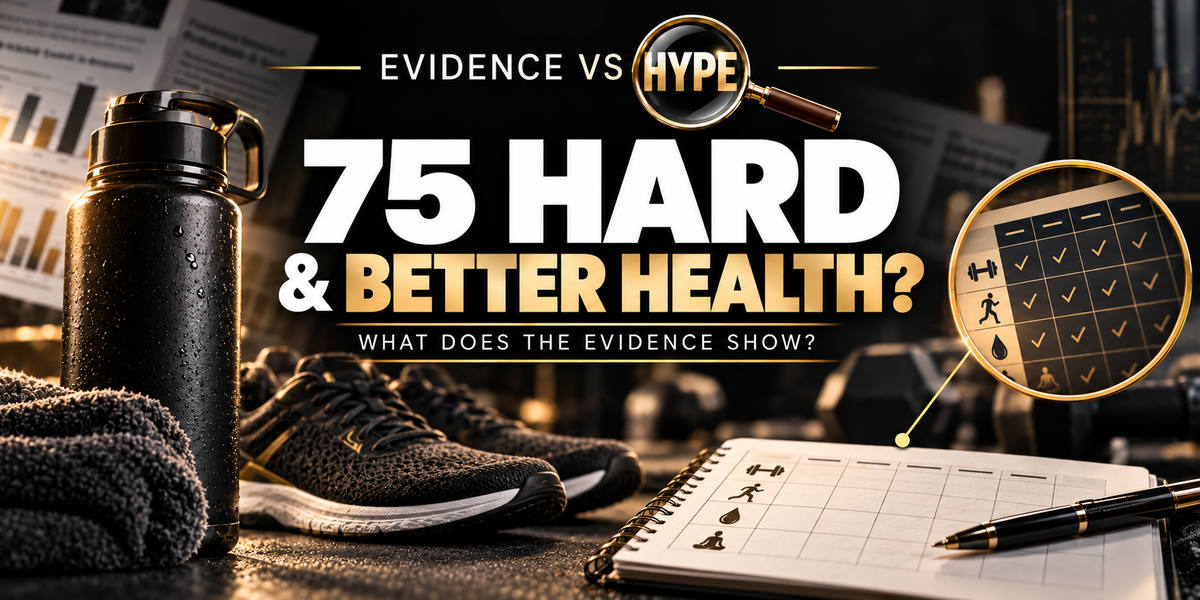
HYPE: 75 Hard creates superior health, fitness and mental toughness.
But what does the evidence actually show?
Two workouts a day, a gallon of water and no missed tasks: 75 Hard offers a very clear challenge. Its useful ingredients should not be confused with proof that the exact rulebook makes people healthier than other approaches.
People may enjoy the structure and improve fitness or confidence. I did not identify a controlled human trial demonstrating superior long-term physical or psychological outcomes from the complete branded programme. The important question is whether the routine suits your body and remains useful after day 75.
What does 75 Hard actually require?
Andy Frisella presents 75 Hard as a mental-toughness programme. For 75 consecutive days, participants follow a diet aligned with their goals, avoid alcohol and cheat meals, complete two separate 45-minute workouts at least three hours apart, with one outside, drink a US gallon of plain water, read ten pages of a suitable nonfiction book and take a progress photograph. Missing a task means restarting. [1]
A US gallon is about 3.8 litres. The programme does not specify one scientifically tested diet or require every workout to be maximal effort. Those distinctions matter: two gentle sessions create a very different load from two demanding workouts.
Why might it help?
A fixed routine removes some daily decisions. Repeated exercise, a consistent eating pattern and visible tracking can give people a sense of progress. Someone previously inactive might make meaningful improvements simply by moving more regularly.
These are plausible explanations for positive experiences, rather than evidence that every rule is essential. Photographs and testimonials also mix changes in exercise, food intake, sleep and motivation. They cannot identify which component worked or show how participants who stopped the challenge fared.
What does the evidence actually show?
Singh et al. (2024)
Time to Form a Habit: A Systematic Review and Meta-Analysis of Health Behaviour Habit Formation and Its Determinants
A 2024 systematic review included 20 habit-formation studies involving 2,601 participants. The time taken to develop automaticity varied widely: the studies reporting timing found ranges spanning days to many months.
Repeated behaviour can strengthen habits, but the review does not establish 75 days as a universal threshold. Many included studies had high risk of bias, and becoming more automatic is different from demonstrating superior health or mental toughness.
Read the research ↗World Health Organization (2020)
WHO Guidelines on Physical Activity and Sedentary Behaviour
WHO guidance recommends 150–300 minutes of moderate aerobic activity, or 75–150 minutes of vigorous activity, per week for adults, plus muscle-strengthening activities on at least two days. Activity can be accumulated in ways that suit the person.
75 Hard requires 630 workout minutes each week. This is not a direct intensity-adjusted comparison: walking and hard running are different. More activity may provide benefits, but health does not require everyone to meet this challenge's exact daily schedule.
Read the research ↗Hew-Butler et al. (2015)
Statement of the Third International Exercise-Associated Hyponatremia Consensus Development Conference
The exercise-associated hyponatraemia consensus identifies drinking beyond fluid losses as an important cause of dangerously low blood sodium during exercise. Fluid needs vary with sweating, duration, body size and conditions.
This does not mean 3.8 litres spread through a day is automatically dangerous. It means a universal compulsory water target is not individualised hydration advice, especially when someone forces fluid they do not need.
Read the research ↗What's the catch? Recovery and sustainability
Training quality depends on the balance between load and recovery. A daily walk can fit comfortably into an exercise programme; repeatedly pushing through pain or exhaustion is a different proposition. The number of sessions alone does not tell us whether training is safe or effective.
The challenge bundles several changes, so weight loss would not prove a special effect of the restart rule or the water target. Its before-and-after photographs do not establish body-fat change, medical benefit or how durable the result is.
Strict rules can feel motivating for one person and punishing for another. There is insufficient programme-specific evidence to claim psychological benefit or harm for everyone. If photographs, food restrictions or restarting make you anxious or encourage compulsive behaviour, that is relevant information about whether this format suits you.
Outdoor exercise can be enjoyable, but illness, extreme weather and medical restrictions are reasons to adapt an ordinary health routine. The commercial programme's rules and a person's health needs are not necessarily identical.
What this means for you
Keep elements that support your goals: regular movement, planned meals, reading and a realistic routine. Build exercise gradually and include the recovery your training needs.
Set hydration around your circumstances and any medical guidance, rather than forcing a challenge quota. Kidney or heart conditions and medicines can change fluid advice.
Judge success by strength, fitness, wellbeing and a routine you can continue. Missing one day does not erase physiological adaptations or the value of previous habits. You can choose a more flexible programme without losing the benefits of regular activity.
75 Hard can provide structure. Its exact rules have not been shown to deliver superior lasting health, and a sustainable routine can retain its useful ingredients.
Research & Sources
1. Andy Frisella / official 75 Hard rules
75 HARD Rules
Primary description of programme requirements · not clinical evidence
Original source ↗2. Singh et al. (2024)
Time to Form a Habit: A Systematic Review and Meta-Analysis of Health Behaviour Habit Formation and Its Determinants
Systematic review · Healthcare
Original source ↗3. World Health Organization (2020)
WHO Guidelines on Physical Activity and Sedentary Behaviour
Public-health guideline
Original source ↗4. Hew-Butler et al. (2015)
Statement of the Third International Exercise-Associated Hyponatremia Consensus Development Conference
International clinical consensus
Original source ↗Evidence reviewed: October 2026
Evidence vs Hype explains scientific research for educational purposes and does not provide individual medical diagnosis or treatment.