Evidence first. Products second.

Psyllium Evidence Hub

Psyllium, also called ispaghula, is a gel-forming soluble fibre. People use it for bowel regularity and as one option for managing LDL cholesterol.

Explore the published investigations below

Psyllium husks in a white bowl beside a glass of water
Defined benefits. Clear limits.

Evidence at a glance

Evidence strength belongs to a specific claim, population and outcome. It is not a score for an ingredient or a brand.

Best-supported uses

Psyllium is a bulk-forming soluble fibre used for bowel regularity and certain forms of constipation. Randomised trials also show reductions in LDL cholesterol. Lower LDL is a measured risk marker, not direct proof that a product prevents heart attacks.

Where uncertainty remains

The size of benefit varies with dose and adherence. LDL reduction is not direct trial evidence of fewer heart attacks. Broad microbiome claims need separate research.

Claims to approach carefully

It is not a detox, a universal gut-health cure or a replacement for prescribed cholesterol treatment. Effects depend on dose, consistent use and the individual.

Who may benefit

Some people with constipation or low fibre intake, and people discussing additional LDL-lowering measures with their clinician.

Who may not need it

People with comfortable regular bowel movements and adequate fibre may not need a supplement. A varied fibre-rich diet remains useful.

Important safety considerations

Never swallow dry. Mix with the fluid amount on the label and drink promptly; maintain adequate fluids unless medically restricted. Start gradually. Avoid with swallowing difficulty or suspected bowel obstruction. Ask a pharmacist about spacing from medicines, as absorption can be affected. Persistent constipation, severe pain, bleeding or vomiting needs medical assessment.

Jovanovski et al.: psyllium and LDL meta-analysis ↗ · Evidence reviewed: October 2026

Evidence first. Products second.

The Evidence Shelf: Psyllium

Useful for defined needs. Start with who may benefit, then consider whether buying anything would add value.

Editorial imagery for the psyllium husk buying guide

UK-led options. Evidence applies to the defined use; formulas and guidance can differ by country.

Illustrative psyllium / ispaghula husk imagery; not the exact commercial example

Illustrative product type

Psyllium / ispaghula husk

MODERATEEvidence for bowel regularity and modest LDL reduction

Best supported for

Supports bowel regularity and modestly lowers LDL.

Why we selected it

Active grams, fluid instructions and medicine-spacing guidance come first.

Do you actually need it?

Useful for a specific fibre-related goal when bulking fibre is safe for you.

Safety before use: Use plenty of fluid and never dry-scoop. Avoid with swallowing difficulty or suspected obstruction; bleeding, severe pain or persistent new bowel changes need assessment. Separate medicines according to label/pharmacist advice. Gas and bloating are common.

Who may benefit & who can skip it

You might benefit: Adults with low fibre intake, appropriate constipation symptoms or an LDL-lowering dietary goal.

You probably do not need it: People whose diet and bowel habits are already satisfactory or who cannot safely swallow a bulking fibre.

What to look for & important limitations

What to look for

Clearly stated active grams, fluid instructions and medicine-spacing advice. Lipid trials commonly used about 10 g/day; constipation products may use different doses. Follow a suitable local label and start gradually.

Important limitations

Jovanovski et al. reported LDL reduction of 0.33 mmol/L at a median 10.2 g/day across 28 trials. AGA-ACG recommends fibre conditionally for constipation, with low certainty and the clearest supplement support for psyllium. These are different claims and do not justify a heart-attack-prevention promise.

Ordinary or free alternatives

Potentially inexpensive and worthwhile. Compare cost per active gram and daily dose; capsules can require many units. Ordinary fibre-rich food remains foundational.

The evidence & product checks

The evidence

What is checked about the product?

No preferred retail brand is cleared. UK Fybogel is a medicine; US Konsyl has an unresolved contaminant-check gap. Organic status does not establish low heavy metals.

Intervention evidence, product-label checks and independent testing are separate. These examples are not claims that one brand is scientifically best.
Evidence reviewed: October 2026. Ratings assess the stated intervention and outcome, not a brand. Product links here are ordinary links with no affiliate tracking. We have not laboratory-tested these products. Affiliate disclosure · How we assess evidence.

Explore all nine Shelf categories →

Explore the claims. Follow the research.

Explore all Psyllium investigations

Each investigation has its own verdict and limitations. New published investigations are added to this collection as the evidence library grows.

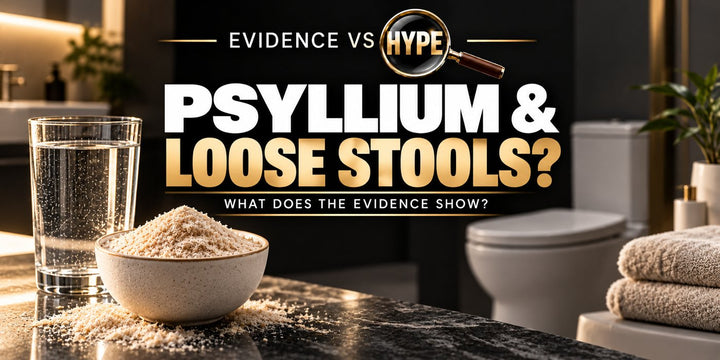
Evidence vs Hype investigation cover: psyllium husks and a glass of water with a discreet bathroom setting, titled Psyllium and Loose Stools?
Read the claim-specific verdict

Can Psyllium Help Manage Loose Stools and Bowel Leakage?

MODERATE — Trials support psyllium for some adults with loose-stool faecal incontinence. They do not establish treatment for every cause of diarrhoea.

Read the evidence →
Evidence vs Hype investigation cover: psyllium husks, water and a person resting a hand on their abdomen, titled Psyllium and IBS?
Read the claim-specific verdict

Does Psyllium Husk Really Improve IBS Symptoms?

MODERATE — Psyllium can improve overall clinical response in some adults with IBS. Benefits vary by symptom, and subtype-specific evidence remains limited.

Read the evidence →
Evidence vs Hype psyllium appetite and weight-loss investigation with husks, water, a plate and neutral scale; no weight-loss result or drug equivalence is illustrated.
Read the claim-specific verdict

Can Psyllium Husk Reduce Appetite and Help With Weight Loss?

UNCLEAR — Short-term fullness is plausible, but weight-loss reviews disagree. Psyllium is not established as equivalent to prescription weight-loss treatment.

Read the evidence →
Evidence vs Hype psyllium and blood-sugar investigation with husks, water, a meal and blank glucose-meter screen; no measurement or treatment result is shown.
Read the claim-specific verdict

Does Psyllium Husk Really Lower Blood Sugar?

MODERATE — Psyllium can improve glucose markers as an adjunct in some people with type 2 diabetes. It is not a replacement for medication or monitoring.

Read the evidence →
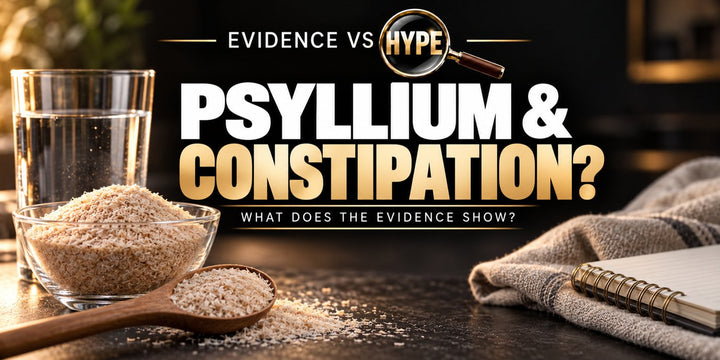
Evidence vs Hype psyllium constipation investigation with tan husks, a spoon, water glass and neutral notebook; no clinical outcome is illustrated.
Read the claim-specific verdict

Does Psyllium Husk Really Relieve Constipation?

MODERATE — Psyllium can improve constipation symptoms in appropriate adults. Response varies, and correct hydration, preparation and assessment matter.

Read the evidence →
Evidence vs Hype psyllium husk and cholesterol investigation in black, white and gold
Read the claim-specific verdict

Does Psyllium Husk Really Lower LDL Cholesterol?

MODERATE — Psyllium can modestly lower LDL cholesterol. Controlled trials support an average benefit, while inconsistency and possible small-study effects limit confidence in the exact size; heart-attack pre...

Read the evidence →