Evidence first. Products second.

Caffeine Evidence Hub

Caffeine is a stimulant found in coffee, tea and some supplements. People use it for alertness and exercise performance; timing and tolerance influence the trade-offs.

Explore the published investigations below

Espresso with golden crema and roasted coffee beans
Defined benefits. Clear limits.

Evidence at a glance

Evidence strength belongs to a specific claim, population and outcome. It is not a score for an ingredient or a brand.

Best-supported uses

Caffeine can improve alertness and reduce perceived fatigue. Exercise research is most consistent for endurance, with smaller or less consistent benefits for some other performance outcomes. Individual responses vary.

Where uncertainty remains

Effects on strength, power and repeated efforts are less consistent than endurance effects. Some people experience mainly side effects.

Claims to approach carefully

It does not replace sleep, fix persistent fatigue or guarantee a better workout. More caffeine does not reliably mean more benefit.

Who may benefit

Healthy adults who tolerate caffeine and want occasional alertness or exercise-performance support without compromising sleep.

Who may not need it

People already consuming caffeine through coffee or tea may need no supplement. Avoid it if the sleep, anxiety or other side effects outweigh any benefit.

Important safety considerations

Count all sources. EFSA identifies up to 200 mg in a single dose and up to 400 mg across a day as amounts without safety concerns for most healthy adults; these are ceilings, not targets. Pregnancy: no more than 200 mg daily. Even 100 mg near bedtime can affect sleep. Avoid bulk pure caffeine powder. Seek advice for heart conditions, interacting medicines or troublesome palpitations.

EFSA: caffeine safety ↗ · Evidence reviewed: October 2026

Evidence first. Products second.

The Evidence Shelf: Caffeine

Useful for defined needs. Start with who may benefit, then consider whether buying anything would add value.

UK-led options. Evidence applies to the defined use; formulas and guidance can differ by country.

Defined-use recommendation

Caffeine for performance

STRONGEvidence for endurance performance on average

Best supported for

Improves endurance performance on average.

Why we selected it

Known caffeine content is useful. No supplement brand is selected.

Do you actually need it?

Optional if you tolerate it and protect sleep; ordinary coffee may be enough.

Safety before use: Insomnia, anxiety, tremor, palpitations and interactions. Pregnancy and medication use require their own limits. Count all caffeine sources and avoid high-dose stacking.

Who may benefit & who can skip it

You might benefit: Healthy adults who tolerate caffeine and want an occasional performance aid.

You probably do not need it: People who dislike the effects, have sleep problems or already obtain enough from ordinary coffee.

What to look for & important limitations

What to look for

Known caffeine content and conservative single-dose control. Research often uses 3–6 mg/kg, but that is not a blanket instruction. Count all sources, protect sleep and avoid bulk pure caffeine powders.

Important limitations

The ISSN review finds the most consistent support for aerobic endurance, with less consistent strength/power effects. Individual response and sleep cost can outweigh a small performance gain. A capsule is not necessary to obtain the effect.

Ordinary or free alternatives

Low priority for a broad health Shelf. Keep as a conditional evidence guide; do not sell the impression that everyone needs a stimulant.

The evidence & product checks

The evidence

What is checked about the product?

No commercial supplement is selected. Coffee is a reasonable alternative; concentration varies. More caffeine does not reliably mean more benefit.

Intervention evidence, product-label checks and independent testing are separate. These examples are not claims that one brand is scientifically best.

Evidence reviewed: October 2026. Ratings assess the stated intervention and outcome, not a brand. Product links here are ordinary links with no affiliate tracking. We have not laboratory-tested these products. Affiliate disclosure · How we assess evidence.

Explore all nine Shelf categories →

Explore the claims. Follow the research.

Explore all Caffeine investigations

Each investigation has its own verdict and limitations. New published investigations are added to this collection as the evidence library grows.

Black-and-gold Evidence vs Hype artwork with coffee and a bedside scene asking whether quitting caffeine improves sleep.
Read the claim-specific verdict

Does Quitting Caffeine Really Improve Sleep, Anxiety and Energy?

LIMITED — Reducing caffeine may help when it contributes to poor sleep or jitteriness. But deliberate abstinence does not reliably improve every habitual user's sleep, and better long-term energy after a 30-...

Read the evidence →
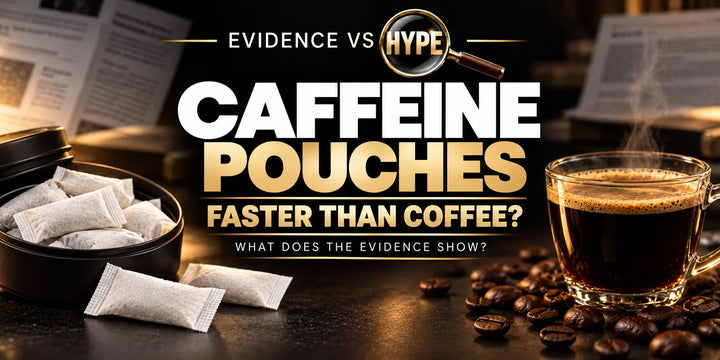
Evidence vs Hype artwork comparing unbranded caffeine pouches with black coffee, asking whether pouches work faster.
Read the claim-specific verdict

Do Caffeine Pouches Work Faster or Better Than Coffee?

WEAK — Reliable evidence that pouches outperform coffee is missing. A prominent five-form absorption study was retracted; gum findings cannot validate pouches.

Read the evidence →
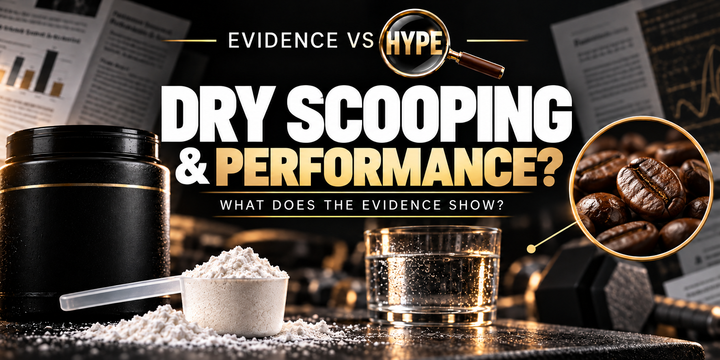
Evidence vs Hype: Does Dry Scooping Pre-Workout Make Supplements More Powerful? Conceptual editorial illustration.
Read the claim-specific verdict

Does Dry Scooping Pre-Workout Make Supplements More Powerful?

WEAK — A concentrated taste, a caffeine rush or skin tingles can make pre-workout feel powerful. Those sensations do not demonstrate better absorption or a stronger training effect from taking powder without...

Read the evidence →
Evidence vs Hype coffee versus caffeine investigation with unbranded coffee, capsules, water and cycling equipment in a balanced comparison.
Read the claim-specific verdict

Is Coffee as Effective as Caffeine Supplements for Exercise?

MODERATE — Coffee can deliver an exercise benefit. Small matched-dose trials support it, but exact equivalence to every supplement across tasks remains uncertain.

Read the evidence →
Evidence vs Hype caffeine and anxiety investigation with coffee, resting hands and a notebook; no inevitable symptoms or clinical diagnosis is depicted.
Read the claim-specific verdict

Does Caffeine Really Increase Anxiety?

MODERATE — Caffeine can increase anxiety symptoms, particularly at high doses and in susceptible people. This does not mean ordinary coffee inevitably causes an anxiety disorder.

Read the evidence →
Evidence vs Hype caffeine tolerance investigation with coffee, a stopwatch and cycling handlebar; no performance improvement is depicted.
Read the claim-specific verdict

Does Caffeine Tolerance Eliminate Its Exercise Benefits?

WEAK — Habitual caffeine use does not universally eliminate exercise benefits. Some controlled studies show attenuation, while regular consumers often retain a response.

Read the evidence →
Evidence vs Hype caffeine and sleep investigation with coffee, a bedside clock and white pillow in the established black, white and gold template.
Read the claim-specific verdict

Does Caffeine Disrupt Sleep Even Six Hours Before Bed?

STRONG — Caffeine can disrupt sleep six hours before bedtime, especially at substantial doses. A universal cut-off cannot account for dose and individual sensitivity.

Read the evidence →
Evidence vs Hype caffeine and fat-loss investigation with espresso, coffee beans, a neutral scale and measuring tape; no weight-loss outcome is depicted.
Read the claim-specific verdict

Does Caffeine Really Help You Burn Fat and Lose Weight?

LIMITED — Caffeine increases short-term energy expenditure, but meaningful, sustained weight loss from caffeine alone remains poorly established.

Read the evidence →
Evidence vs Hype caffeine and exercise performance investigation with coffee, running shoes and stopwatch
Read the claim-specific verdict

Does Caffeine Really Improve Endurance and Workout Performance?

STRONG — Caffeine reliably improves endurance performance on average. Benefits for strength, power and repeated efforts are usually smaller and less consistent, and some people mainly experience side effects.

Read the evidence →