Evidence first. Products second.

Creatine Evidence Hub

Creatine helps supply energy during brief, intense efforts. Plain monohydrate is the form most closely studied for exercise performance.

Explore the published investigations below

Unbranded white creatine powder with a metal scoop on pale stone
Defined benefits. Clear limits.

Evidence at a glance

Evidence strength belongs to a specific claim, population and outcome. It is not a score for an ingredient or a brand.

Best-supported uses

Human trials support improved strength and repeated high-intensity exercise performance, with additional resistance-training adaptations. Changes in lean mass can include water; actual muscle-growth effects are more qualified.

Where uncertainty remains

Memory and cognitive effects vary across populations and remain less established than exercise outcomes. Claims about hair loss need their own evidence assessment.

Claims to approach carefully

It does not replace training, guarantee muscle growth or establish every claim about memory, hair or longevity.

Who may benefit

Adults doing resistance training or repeated high-intensity exercise who want a modest additional benefit.

Who may not need it

People whose goals do not involve these outcomes, or who prefer to focus on training and diet first.

Important safety considerations

Common maintenance protocols use 3–5 g daily; loading is optional. Water-weight gain and digestive discomfort can occur. People with kidney disease, pregnancy or relevant medicines should seek professional advice before use.

ISSN creatine position stand ↗ · Evidence reviewed: October 2026

Evidence first. Products second.

The Evidence Shelf: Creatine

Useful for defined needs. Start with who may benefit, then consider whether buying anything would add value.

Fine white creatine powder in a clean measuring scoop beside a glass of water; illustrative product type, not a branded product.

UK-led options. Evidence applies to the defined use; formulas and guidance can differ by country.

Fine white creatine powder in a clean measuring scoop beside a glass of water; illustrative product type, not a branded product.

Illustrative product type

Creatine monohydrate

STRONGEvidence for strength gains with training

Best supported for

Adds to strength gains during progressive resistance training.

Why we selected it

Plain monohydrate matches the form most closely studied for exercise.

Do you actually need it?

Useful alongside regular resistance training; it cannot replace training.

Safety before use: Water-weight gain and gastrointestinal upset can occur. People with kidney disease or complex medical care should obtain individual advice. Creatinine can rise without establishing kidney damage; disclose use to clinicians.

Who may benefit & who can skip it

You might benefit: Adults doing regular resistance training or repeated high-intensity sport. Benefits are incremental to training.

You probably do not need it: People expecting a substitute for training, a universal endurance boost, or proven prevention of dementia or ageing.

What to look for & important limitations

What to look for

Choose single-ingredient monohydrate. Typical research maintenance is 3–5 g/day; loading is optional. The label distinguishes creatine from monohydrate mass. Follow the current pack rather than assuming every scoop weighs 5 g.

Important limitations

Wang et al. pooled 23 trials in adults under 50: additional upper-body strength 4.43 kg and lower-body 11.35 kg versus placebo plus training. These are pooled exercise-specific tests, not promised personal gains. The evidence is heavily male; a non-significant female subgroup does not demonstrate that women cannot benefit. Muscle-size outcomes and recovery deserve separate ratings.

Ordinary or free alternatives

Worth considering when training consistently. Compare cost per 3-5 g of active monohydrate, not scoop or tub. No reliable current Amazon price comparison was completed.

The evidence & product checks

The evidence

What is checked about the product?

The UK manufacturer identifies the monohydrate formula and 317 g option. Website serving-count information varies; confirm the pack. No current batch assay or evidence of brand superiority is claimed.

Intervention evidence, product-label checks and independent testing are separate. These examples are not claims that one brand is scientifically best.

Evidence reviewed: October 2026. Ratings assess the stated intervention and outcome, not a brand. Product links here are ordinary links with no affiliate tracking. We have not laboratory-tested these products. Affiliate disclosure · How we assess evidence.

Explore all nine Shelf categories →

Explore the claims. Follow the research.

Explore all Creatine investigations

Each investigation has its own verdict and limitations. New published investigations are added to this collection as the evidence library grows.

Evidence vs Hype creatine and bone-health investigation with powder and scoop, an anatomical hip model and conceptual bone detail; no treatment outcome is implied.
Read the claim-specific verdict

Does Creatine Improve Bone Health or Prevent Osteoporosis?

WEAK — Creatine has not established an additional bone-density or osteoporosis-prevention benefit. Promising bone-geometry signals do not prove fewer fractures.

Read the evidence →
Evidence vs Hype creatine and endurance investigation with powder and scoop, running shoe, cyclists and a conceptual magnified powder inset.
Read the claim-specific verdict

Does Creatine Really Improve Endurance Performance?

WEAK — Creatine has not shown a reliable overall endurance benefit in trained athletes. Repeated high-intensity efforts are a narrower, separate claim.

Read the evidence →
Evidence vs Hype creatine and plant diets investigation with unbranded powder, scoop, lentils, tofu and greens.
Read the claim-specific verdict

Do Vegetarians Benefit More from Creatine Supplementation?

LIMITED — Vegetarians often have lower initial muscle creatine stores, but greater strength, muscle or sport gains than omnivores are not consistently established.

Read the evidence →
Evidence vs Hype creatine timing investigation with powder and scoop, an analogue clock, dumbbell and conceptual magnified powder.
Read the claim-specific verdict

Should You Take Creatine Before or After a Workout?

LIMITED — Direct trials have not established that taking creatine before or after training reliably produces superior strength or muscle gains. Consistency is more defensible than a narrow window.

Read the evidence →
Evidence vs Hype creatine and ageing investigation, with creatine powder, an older adult holding a dumbbell and a conceptual muscle inset.
Read the claim-specific verdict

Does Creatine Help Older Adults Build Strength and Preserve Muscle?

MODERATE — Creatine can modestly improve strength gains alongside resistance training in healthy older adults. Muscle mass, function and frailty claims need more evidence.

Read the evidence →
Evidence vs Hype — Creatine and hydration: powder, a glass of water and an athletic calf with conceptual muscle-water magnification.
Read the claim-specific verdict

Does Creatine Cause Dehydration or Muscle Cramps?

Does creatine cause dehydration or cramps? Examine controlled heat studies, body-water changes and what athlete observations can establish.

Read the evidence →
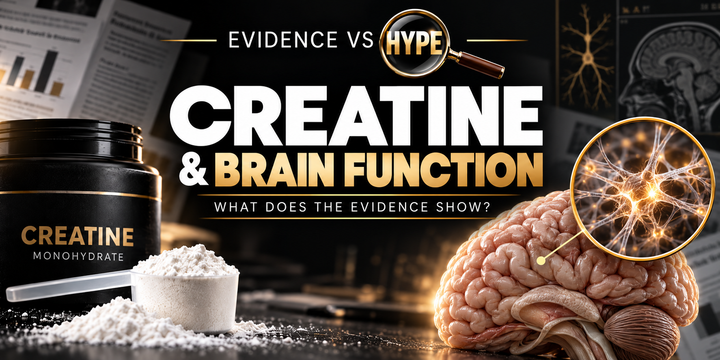
Evidence vs Hype — Creatine and brain function: powder and a brain model with conceptual magnified neural tissue.
Read the claim-specific verdict

Does Creatine Improve Memory and Brain Function?

Does creatine improve memory and brain function? Explore cognitive trials, sleep-deprivation research and limits of positive meta-analyses.

Read the evidence →
Evidence vs Hype — Creatine loading and cycling investigation with powder, dosing cues and a conceptual scientific muscle illustration.
Read the claim-specific verdict

Do You Need to Load or Cycle Creatine?

Loading speeds muscle saturation, but is it necessary? Explore gradual dosing, maintenance, serving size and the evidence on cycling.

Read the evidence →
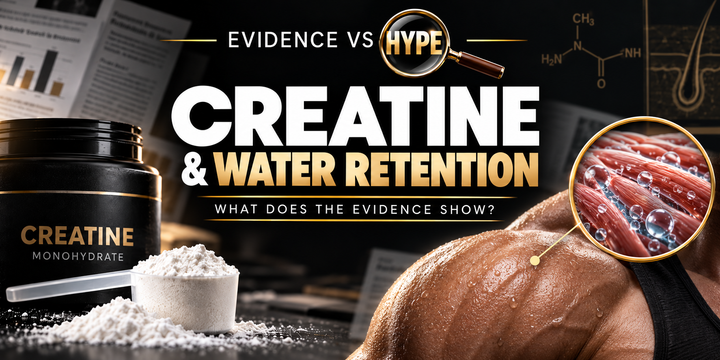
Evidence vs Hype — Creatine and water retention: powder, muscle anatomy and a conceptual magnified view of muscle water.
Read the claim-specific verdict

Does Creatine Make You Bloated or Cause Water Retention?

Does creatine cause bloating or water retention? Separate muscle water, scale weight, digestive discomfort and visible puffiness.

Read the evidence →
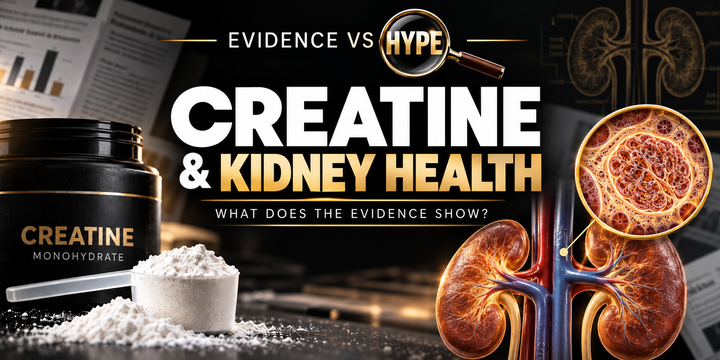
Evidence vs Hype — Creatine and kidney health: powder and an anatomical kidney model with conceptual renal-tissue magnification.
Read the claim-specific verdict

Does Creatine Damage Your Kidneys?

Does creatine damage healthy kidneys? We examine creatinine, directly measured filtration and what trials can tell us about safety.

Read the evidence →
Evidence vs Hype investigation: Creatine, muscle and strength, with creatine powder, a dumbbell and a shoulder illustration in black, white and gold.
Read the claim-specific verdict

Does Creatine Really Help You Build Muscle and Get Stronger?

Does creatine build muscle and improve strength? We examine added training benefits, meaningful effect sizes, water weight, safety and the limits of the evidence.

Read the evidence →
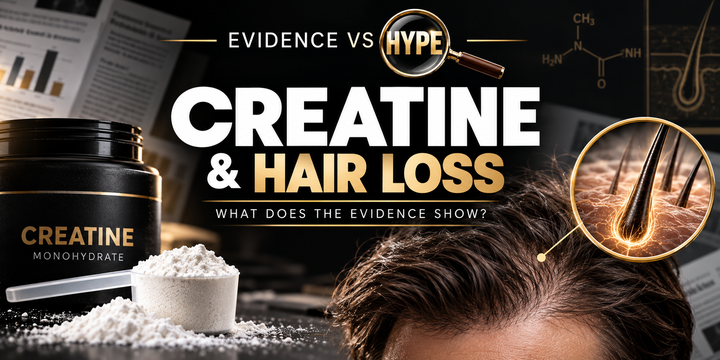
Does Creatine Cause Hair Loss? What the Evidence Actually Shows
Read the claim-specific verdict

Does Creatine Cause Hair Loss? What the Evidence Actually Shows

Creatine is often blamed for hair loss because of one small 2009 study involving DHT. But researchers have now directly tested creatine and hair health. Here's what the evidence shows.

Read the evidence →