
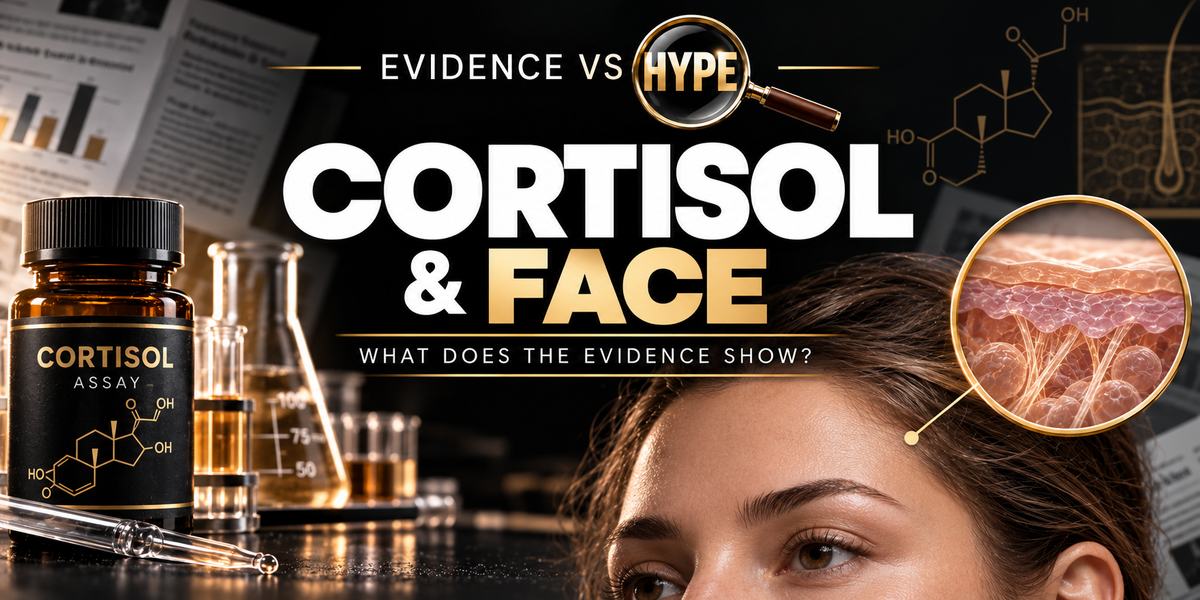
HYPE: Stress is giving you “cortisol face”.
But what does the evidence actually show?
Ordinary stress can alter cortisol, but facial puffiness alone does not show that cortisol is high or that stress caused it.
Prolonged pathological cortisol excess, as in Cushing’s syndrome, can cause a rounder face. That is a different claim from a stressful week automatically producing the same condition. Searches of recent research did not identify controlled human evidence validating the viral everyday-stress “cortisol face” explanation.
The hype
The claim usually begins with a familiar observation: “My face looks puffier when I am stressed.” It then becomes a hormonal explanation, sometimes followed by a promise that a supplement, drink or cortisol-lowering routine will reverse it.
It is reasonable to wonder whether stress affects appearance. The scientific task is to establish the chain from stress, to sustained hormone exposure, to a measurable facial change — and to distinguish that change from other causes.
Why people believe this
Cortisol is made by the adrenal glands and helps regulate energy availability, blood pressure and the stress response. It is necessary for normal health, rather than a toxin to eliminate. Its production is controlled through signals between the brain, pituitary and adrenal glands.
Stress can increase cortisol, and prolonged glucocorticoid excess can affect fat distribution and facial appearance. That gives the idea a plausible starting point. The leap is assuming that a normal stress response produces the same exposure and clinical effects as an endocrine disorder or prolonged steroid treatment.
What does the evidence show?
Zoccola and colleagues (2025 journal issue)
Researchers pooled 13 acute laboratory-stress studies involving 1,258 adults. They identified several cortisol-response patterns, with social-evaluative threat associated with more reactive patterns. This establishes variation in stress responses; it did not test facial puffiness or “cortisol face”.
Read the research ↗A hormone measurement answers a different question from a facial outcome. Even a well-conducted stress experiment cannot demonstrate a cosmetic effect that was not measured. It also does not justify assuming that everyone who feels stressed has continuously high cortisol.
Planert and colleagues (2026)
This study examined hair cortisol and stress reactivity in 72 healthy people. Its research question concerned the relationship between life stress and a longer-term hormone marker. It was not a trial of facial swelling or a treatment to reverse it.
Read the research ↗Hair cortisol is a research biomarker, not a facial diagnosis. The recent stress literature helps explain why “I feel stressed” and “my cortisol must be high” are not interchangeable statements. Neither study closes the missing link between everyday stress and the viral facial claim.
Cushing’s syndrome: the real clinical distinction
Cushing’s syndrome involves prolonged excessive glucocorticoid exposure. The NHS identifies long-term high-dose steroid medicines as the most common cause; hormone-producing growths can also cause endogenous cortisol excess. Cushing’s disease specifically refers to a pituitary cause.
Facial rounding can occur alongside changes elsewhere in the body. Progressive central weight gain, easy bruising, stretch marks and weakness in the upper arms or legs provide a different clinical picture from isolated morning puffiness. A face alone cannot confirm or exclude Cushing’s.
The distinction is not that cortisol never changes a face. It is that evidence from a recognised medical condition cannot automatically validate a popular explanation for ordinary fluctuations in appearance.
What else could explain puffiness?
Facial fullness, temporary fluid swelling and Cushingoid fat redistribution are not identical outcomes. Sleep, salt-related fluid retention, overall weight changes and medicines can affect appearance. Thyroid disease is another possible medical explanation for facial swelling. These are possibilities to assess, not diagnoses to make from a photograph.
Sudden swelling may involve allergy or angioedema, particularly around the lips, tongue and eyelids. Calling all of these changes “cortisol face” risks treating different problems as though they have one cause.
The catch
Before-and-after images are difficult evidence: lighting, camera angle, expression, weight and timing may all change. A person can look different after improving sleep or changing several habits without proving that cortisol mediated the improvement.
A useful trial would measure stress, appropriately timed cortisol exposure and objective facial outcomes, with a comparison group and alternative explanations addressed. This review found no such direct evidence establishing the broad viral claim. Absence of that evidence does not prove that stress can never contribute indirectly.
The Endocrine Society recommends targeted assessment when the clinical features justify it, rather than widespread screening. A random cortisol blood result is not recommended as a stand-alone test for Cushing’s syndrome. Timing and clinical context matter.
What this means for you
Treat “cortisol face” as an unconfirmed explanation, rather than a diagnosis. Supporting sleep and managing stress can be worthwhile without promising to reshape your face by lowering a hormone.
Speak to a GP about persistent, unexplained or progressive facial changes, especially when accompanied by other symptoms or steroid use. Do not abruptly stop prescribed steroid medication; any adjustment should be guided by the prescriber.
Call 999 for sudden swelling of the lips, mouth, throat or tongue, difficulty breathing or difficulty swallowing. Those symptoms should not be managed as a stress trend.
The underlying hormonal link is real. The everyday-stress diagnosis is not established.
The cause of a facial change matters more than the label attached to it online.
Research & Sources
Zoccola et al. (2025; online 2024)
The role of social-evaluative threat for cortisol profiles in response to psychosocial stress: A person-centered approach.
Planert et al. (2026)
Linking hair cortisol and life stress: The role of stress reactivity and habituation.
NHS (reviewed 2025)
Cushing’s syndrome: causes, symptoms and assessment.
Endocrine Society • clinical guideline
Diagnosis of Cushing’s Syndrome: who should be tested and appropriate tests.
Endocrine Society
Cushing’s Syndrome and Cushing Disease: prolonged excess versus normal physiology.
Cleveland Clinic
Moon Face: Causes & Treatment.
NHS (Evidence reviewed: August 2026)
Angioedema: facial swelling and emergency symptoms.
Evidence reviewed: October 2026. Searches included 2025 and 2026 research as well as relevant older studies. This is an editorial investigation, not an exhaustive systematic review.
Evidence vs Hype explains scientific research for educational purposes and does not provide individual medical diagnosis or treatment.