
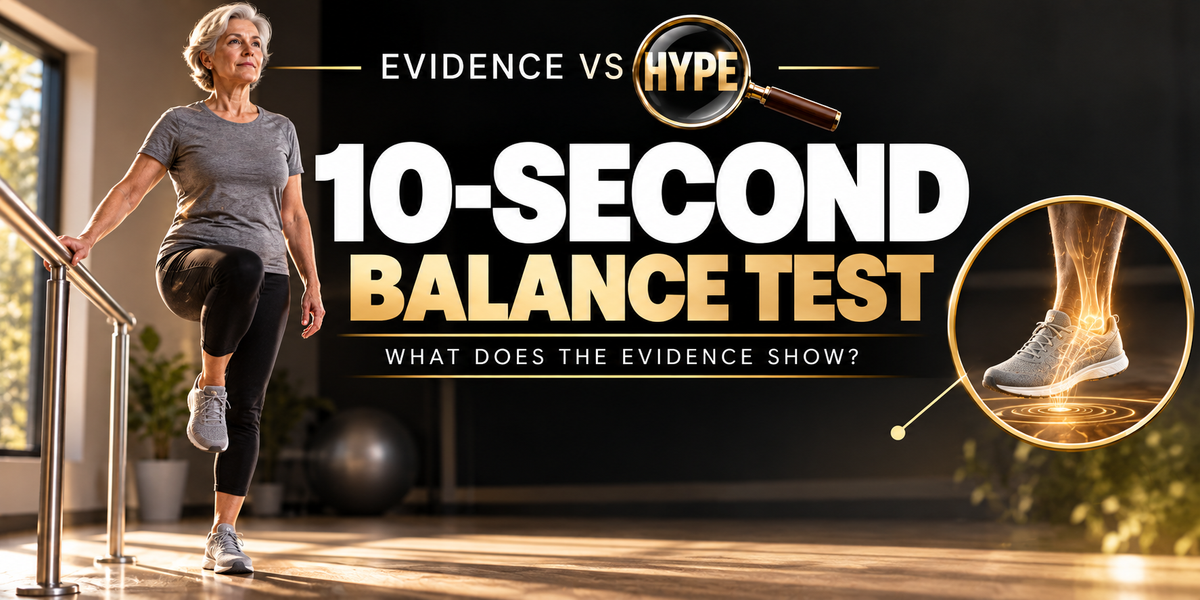
HYPE: A ten-second balance test can tell you how long you will live.
But what does the evidence actually show?
Failure to complete a ten-second one-leg stance was associated with higher mortality in one middle-aged and older cohort. It cannot tell an individual how many years they have left, and improving the score has not been shown to extend life.
What the test is supposed to tell us
Balance is a useful aspect of physical function. The fair version of the claim is that a simple test might add information to a broader health assessment. The exaggerated version turns a brief wobble into a personal lifespan forecast.
Those are different uses of a measurement. A risk marker can help distinguish groups without accurately predicting what happens to any one member. A test also needs validation in the population and setting where it will be used.
The study behind the headline
Araújo and colleagues studied 1,702 adults aged 51–75, 68% of whom were men. Around one-fifth could not complete the stance. During a median follow-up of seven years, mortality was higher among those who failed. After adjustment for several measured risk factors, the hazard ratio was 1.84, with a 95% confidence interval of 1.23–2.78. [1]
That is an association between groups. It does not mean a person who fails has an 84% probability of dying, loses 84% of their lifespan or will die within seven years. A hazard ratio compares rates over follow-up; it is not a personalised countdown.
Why balance might carry information
Standing on one leg draws on several systems: sensory information, coordination and the ability to control posture. A poor result may therefore reflect aspects of broader health and function. That makes it plausible as a marker, without establishing that the balancing act itself controls longevity.
Think of the distinction between a warning light and the underlying problem. Changing the visible signal is not necessarily the same as changing the factors it reflects. A meaningful assessment asks why balance is difficult, rather than simply rehearsing the test until the number improves.
What adjustment can and cannot do
The researchers accounted for age, sex, body mass index and comorbidities in their reported model. That reduces some alternative explanations, but it does not create randomisation. The paper itself notes uncontrolled factors including physical activity and recent falls. [1]
People who fail may differ in other relevant ways that were not fully measured. The result could partly capture existing health problems that affect both balance and survival. It remains useful research, but the causal claim must stay narrower than the association.
Prediction is more than a statistically significant link
A test can be associated with an outcome yet be insufficiently accurate for screening on its own. To judge clinical usefulness, researchers also need to examine how well predictions match actual outcomes, whether performance transfers to other populations and whether using the test improves decisions.
This cohort does not represent every age, disability or health condition. A young athlete, a person with a temporary ankle injury and an older adult with recurrent falls should not receive the same interpretation from an identical result. Test conditions and technique matter too.
Does practising balance make you live longer?
That question was not tested. The study observed a baseline ability and subsequent outcomes; it did not assign a balance-training intervention and show a survival benefit. We should not convert “people with better balance had lower risk” into “ten seconds of daily practice prevents death”.
Balance can still be worth developing for its role in function. General activity guidance includes maintaining strength, balance and flexibility, particularly as people age. [2] The sensible reason to work on these abilities is what they help you do, not a promise that passing one test adds a fixed number of years.
What this means for you
Do not use this as a home diagnosis or a reason to panic. If you choose to explore your balance, have stable support within reach and avoid any situation where falling could injure you. The featured artwork shows support for safety; it is not a demonstration of the research test protocol.
Persistent balance difficulty, recurrent falls or a new change deserves discussion with a health professional. A sudden severe balance problem, especially with other neurological symptoms, needs urgent assessment. [3] Passing the test is not a substitute for broader health care, and failing it is not a verdict on your future.
An interesting marker of health and function—not a ten-second lifespan calculator.
Research & Sources
1. Araújo et al. (2022). Successful 10-second one-legged stance performance predicts survival in middle-aged and older individuals. British Journal of Sports Medicine.
Read the original source ↗2. NHS Inform. Physical activity guidelines.
Read the original source ↗3. NHS. Transient ischaemic attack: symptoms.
Read the original source ↗Evidence reviewed: October 2026
This editorial investigation is not an exhaustive systematic review. Sources were checked against accessible research records; abstract-only records are not presented as full-text assessments. Evidence vs Hype provides education, not individual diagnosis or treatment. Featured artwork is conceptual, not a study result.