
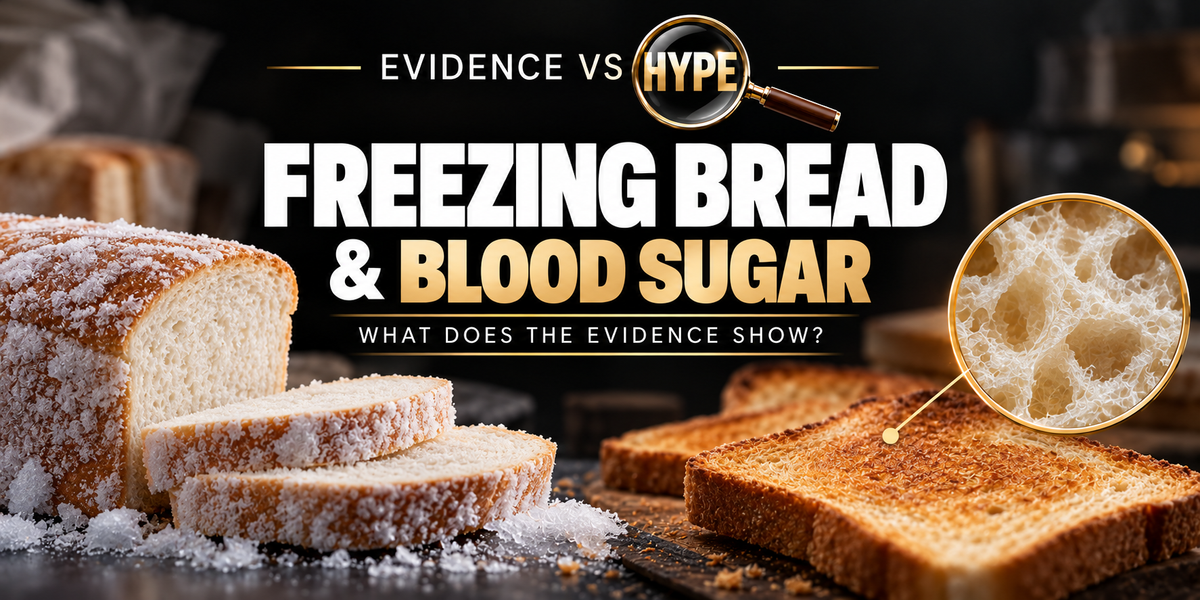
HYPE: Freeze your bread and it stops spiking blood sugar.
But what does the evidence actually show?
A small human experiment found lower glucose responses after some freezing and toasting procedures. It did not show that frozen bread becomes carbohydrate-free, prevents diabetes or produces the same result for every loaf and person.
What the claim gets right
Food preparation can change how starch behaves. Bread is not nutritionally identical in every physical state simply because the ingredient list is unchanged. The reasonable question is whether cooling, freezing and reheating alter how quickly its starch is digested.
The exaggerated claim is much broader: that putting a loaf in the freezer neutralises its carbohydrate or transforms white bread into a treatment for metabolic disease. That conclusion would require outcomes and trials very different from a short blood-glucose experiment.
Why resistant starch is plausible
Some cooked starch can reorganise as it cools, a process called retrogradation. A portion may become less accessible to digestive enzymes and behave as resistant starch. This provides a plausible explanation for altered digestion, but does not mean every preparation produces the same amount.
Recipe, starch structure, storage and reheating can all matter. A mechanism involving part of the starch does not justify subtracting a fixed percentage from the calories or carbohydrate on a bread label. Measuring a glucose response is also not the same as directly quantifying resistant starch in the food.
The small trial behind the headline
Burton and Lightowler tested ten healthy adults using homemade and commercial white bread under four conditions: fresh, frozen and defrosted, toasted, and frozen, defrosted and toasted. Glucose was measured over two hours in a randomised repeated-measures design. [1]
Responses were lower after several preparation methods, but the pattern differed by bread. For homemade bread, freezing and defrosting significantly lowered the incremental glucose area under the curve. For commercial bread, the significant comparisons reported in the abstract involved toasting, with or without prior freezing. Freezing alone should not be described as a uniform success across both breads.
What the outcome actually means
Area under the glucose curve summarises the rise over a period of time. A lower incremental area is not the same as eliminating the peak, preventing every glucose rise or reducing total carbohydrate absorption by the same percentage. The outcome needs to retain its original meaning.
The study also compared prepared portions under research conditions. It does not tell us the effect of every sandwich filling, portion size or mixed meal. A freezer instruction on social media cannot reproduce all those conditions merely by specifying a storage time.
Useful newer starch research is not the same intervention
A 2025 randomised crossover study tested bread made from wheat with elevated amylose, using glucose monitoring in 26 healthy adults. [2] That research supports investigating starch composition, but specially selected wheat is not equivalent to freezing an ordinary loaf.
This distinction matters when claims collect several papers under the heading “resistant starch”. A trial can be scientifically relevant to the mechanism without directly proving the household hack. Evidence for a specially formulated food should not be transferred to every supermarket bread.
The catch / limitations
The direct freezing study had only ten participants, all described as healthy, and measured short-term responses. It did not test long-term HbA1c, diabetes incidence, body weight or medication needs. Small crossover experiments can detect an acute signal while leaving its durability and clinical importance uncertain.
There is also no basis here for an exact claim such as “freeze for this many hours and cut your glucose response by the same amount”. Storage methods and bread types are part of the experiment, not interchangeable details.
What this means for you
Freezing bread can be a practical way to store portions and reduce waste. If you like toast made from previously frozen bread, there is no need to treat the habit as pointless. Just keep the expected metabolic benefit modest and uncertain.
Continue to consider portion size, the whole meal and the bread's nutritional composition. Freezing does not remove gluten, make an unsuitable food safe for an allergy or turn a refined loaf into wholegrain bread. If you use carbohydrate counting or glucose-lowering medication, do not change your calculations or treatment based on this small trial alone.
A potentially useful preparation effect is worth studying. It is not a licence to promise that a freezer removes the consequences of any amount of bread.
A plausible preparation effect with small-trial support—not a proven way to neutralise bread's carbohydrate or prevent diabetes.
Research & Sources
1. Burton and Lightowler (2008; online 2007). The impact of freezing and toasting on the glycaemic response of white bread. European Journal of Clinical Nutrition.
Read the original source ↗2. Effect of wheat bread with elevated amylose on postprandial glycaemic response: randomised crossover trial (2025). Food & Function. Different intervention from freezing ordinary bread.
Read the original source ↗Evidence reviewed: October 2026
This editorial investigation is not an exhaustive systematic review. Sources were checked against accessible research records; abstract-only records are not presented as full-text assessments. Evidence vs Hype provides education, not individual diagnosis or treatment. Featured artwork is conceptual, not a study result.