
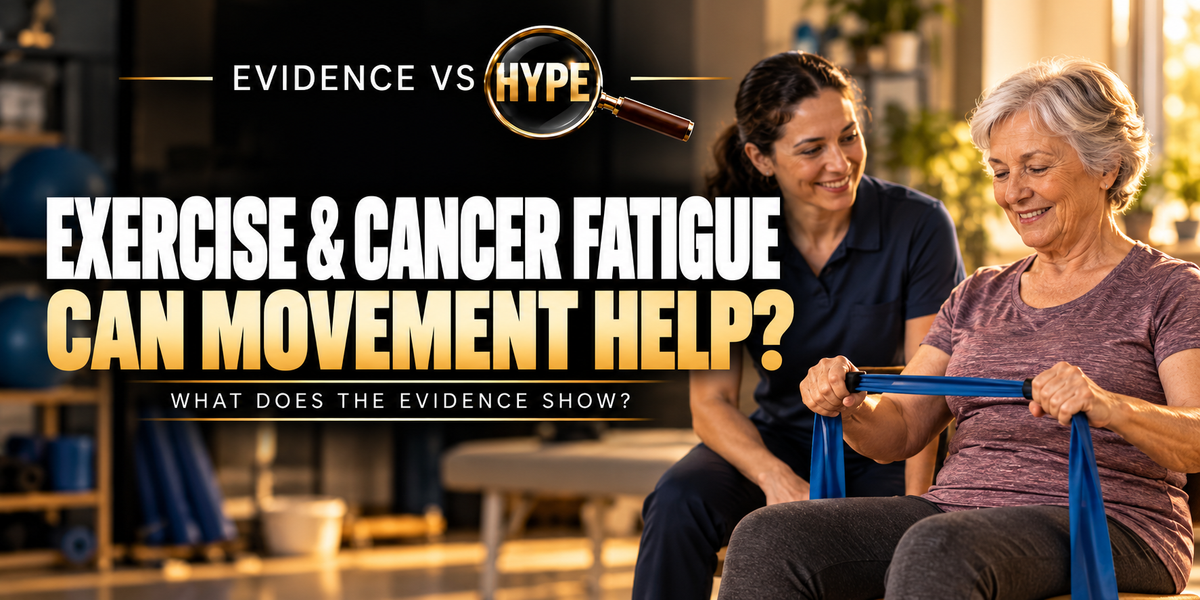
HYPE: Appropriately adapted exercise reduces cancer-related fatigue during and after treatment in studied adult populations.
But what does the evidence actually show?
Appropriately adapted exercise can reduce cancer-related fatigue during and after treatment. Evidence is moderate, and the programme needs to fit the person's condition, treatment and capacity.
The claim
Appropriately adapted exercise reduces cancer-related fatigue during and after treatment in studied adult populations. The rating below applies to this specific outcome and population, rather than every claim associated with the subject.
Why people believe it
When someone feels exhausted, rest can seem the only sensible response. Yet cancer-related fatigue is complex, and exercise has been tested as a structured supportive intervention. The relevant claim is a reduction in fatigue severity, not curing cancer or requiring people to push through every symptom. [1] [2]
What the evidence actually shows
A guideline supports exercise with qualified certainty
The 2024 ASCO–Society for Integrative Oncology guideline reviewed 113 randomised trials across fatigue-management interventions. Exercise, cognitive behavioural therapy and mindfulness programmes improved fatigue during and after cancer treatment. The guideline described the certainty and quality of the evidence as low to moderate, an important limit even when recommendations favour an intervention. [1]
Earlier pooled trials also found a benefit
A 2017 meta-analysis included 113 studies and 11,525 participants across exercise, psychological, combined and pharmaceutical approaches. Exercise produced a small-to-moderate standardised improvement in fatigue. Those totals cover all the intervention categories, not 113 exercise-only trials, and a pooled standardised effect is not a fixed percentage improvement for each person. [2]
The outcome is supportive care
These findings concern cancer-related fatigue severity. They do not show that exercise replaces oncology treatment, that all fatigue has the same cause, or that a programme is appropriate in every phase of advanced illness. The updated guideline treats end-of-life care separately and includes other supportive approaches. [1]
The limitations
Programmes, cancer types, treatment phases and fatigue scales vary. Participants able to join an exercise trial may differ from people with major complications or very limited function. It is also difficult to blind participants to exercise, and self-reported fatigue can be influenced by expectations and support. [1] [2]
The older meta-analysis and newer guideline are related evidence syntheses, not two wholly separate sets of independent proof. A beneficial average does not guarantee response, and the findings should not be transferred to ME/CFS or other fatigue conditions with different evidence and management. [1] [2]
What this means for you
If fatigue is affecting you during or after cancer treatment, ask the oncology team about an appropriate activity or rehabilitation programme. The purpose is a manageable supportive intervention, adjusted to current symptoms and medical circumstances, rather than an instruction to exercise harder. [1]
New, worsening or disabling fatigue deserves assessment. Exercise is one option within supportive care, alongside approaches such as CBT or mindfulness where appropriate. Difficulty exercising is not a failure, and this research is not a reason to ignore symptoms or stop prescribed treatment. [1] [2]
Research & Sources
1. Bower et al. (2024). Management of fatigue in adult survivors of cancer: ASCO–Society for Integrative Oncology guideline update.
Read the original source ↗2. Mustian et al. (2017). Exercise, psychological and pharmaceutical treatments for cancer-related fatigue: meta-analysis.
Read the original source ↗Evidence reviewed: October 2026
This targeted editorial review considered evidence available by 25 October 2026. It is not an exhaustive systematic review or independent clinical peer review. Assessment used available full texts, research abstracts and authoritative guidance; some publisher full texts were inaccessible. Evidence vs Hype provides education, not individual diagnosis or treatment. Featured artwork is AI-generated editorial illustration, not a study result or product endorsement.