
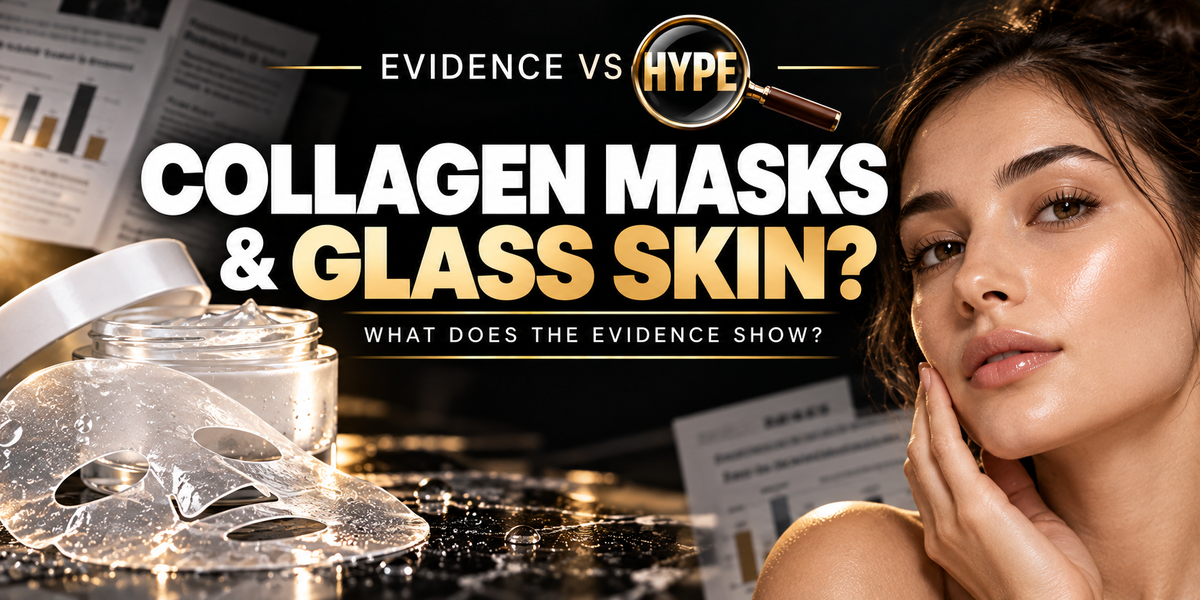
HYPE: A collagen mask rebuilds collagen and creates glass skin.
But what does the evidence actually show?
Hydration and temporary smoother-looking skin are plausible and supported by some small studies. Proof of meaningful new dermal collagen from viral masks is much weaker.
The hype
A clear, close-fitting mask promises a dewy result after hours of wear. Immediate softness and shine can be satisfying. The stronger claim is structural rebuilding of skin, which requires different evidence from a freshly moisturised photograph.
Why it sounds plausible
A hydrogel holds water against the skin and may reduce evaporation. Surface hydration can temporarily soften the appearance of fine lines. Collagen in a mask is not automatically delivered intact into the dermis or incorporated into the skin’s collagen network.
What does the evidence show?
A 2024 paper reported clinical studies of one native-collagen mask formulation, alongside laboratory work, with improvements in hydration and skin appearance. These results are formulation-specific; fibroblast findings do not demonstrate new collagen in a wearer’s skin. [1]
A 2026 open-label pilot tested a hydrogel facial mask containing hyaluronic acid and other ingredients, but no collagen, in 15 participants for six weeks, with laboratory experiments also included. Signals in hydration and firmness are interesting, but an uncontrolled small pilot cannot isolate the product effect or establish durable collagen rebuilding. [2]
The catch / limitations
Hydration, wrinkle appearance, elasticity and actual dermal collagen are different endpoints. Small samples, limited follow-up and ingredient-to-product extrapolation leave substantial uncertainty. “Glass skin” is an aesthetic description, not a standard clinical outcome.
Safety and practical context
Follow the stated wear time rather than assuming overnight use is better. Stop if burning, itching or redness develops. A mask is not a replacement for assessment of persistent skin problems or routine sun protection.
What this means for you
Treat a mask as an optional moisturising experience. A next-morning glow can be real without meaning that ageing has been reversed.
A hydration boost is credible; collagen rebuilding is a larger, unproven promise.
Research & Sources
1. Clinical and laboratory study of a native collagen mask
Original source ↗2. 2026 pilot of a hydrogel facial mask without collagen
Original source ↗Correction, October 2026: Clarified that the 2026 pilot tested a hydrogel facial mask without collagen.
Evidence reviewed: October 2026
Evidence vs Hype explains scientific research for educational purposes and does not provide individual medical diagnosis or treatment. Featured artwork illustrates the claim under investigation, not a proven effect.